
 Email:
  Whatsapp:

Clear records
history record

News

Related news
What Is a Motor Encoder? Complete Guide to Types and Applications
By converting the motor’s rotational angle into digital signals, the encoder provides accurate position and speed feedback to the control system. This ensures precise motion, stable operation, and high efficiency in modern manufacturing and automation applications.
What Is a Motor Encoder?
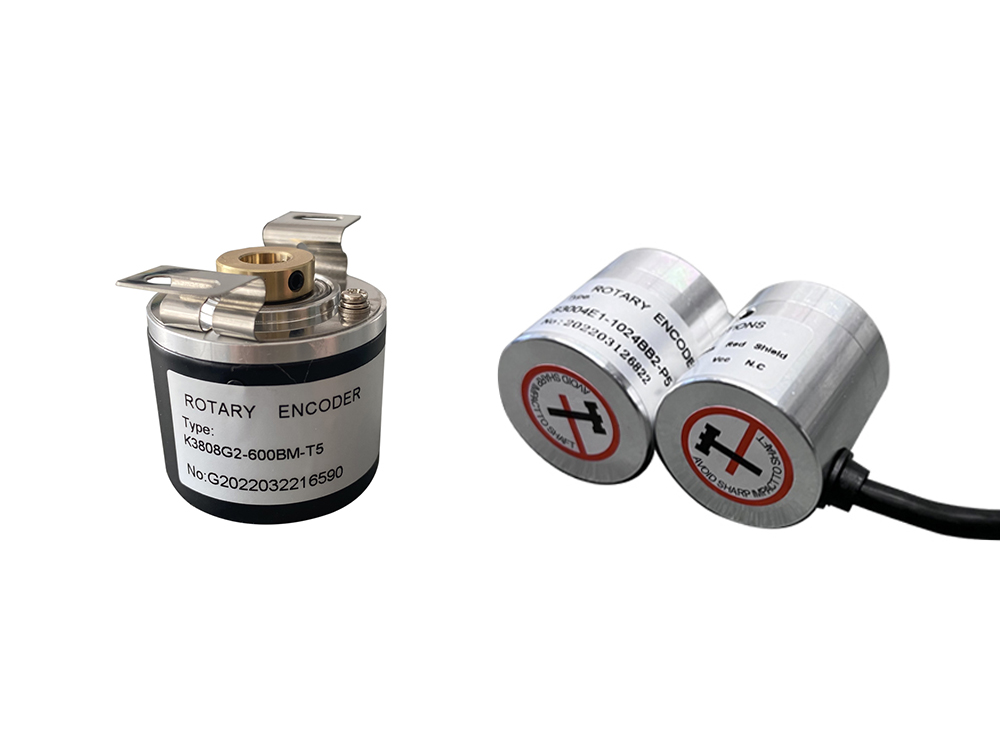
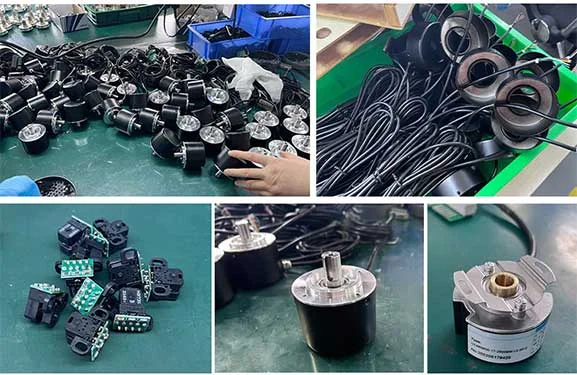
A motor encoder is a sensor that detects the rotation angle, speed, and direction of a motor shaft.
By converting mechanical motion into electrical signals, it provides real-time position feedback to the control system, enabling closed-loop control.
In other words, an encoder makes the motor “think.” The system can precisely determine the current position and motion status through feedback signals, correct errors instantly, and achieve high-precision control.
In CNC machines, it defines tool movement accuracy; in robotics, it ensures smooth and coordinated joint motion.
Working Principle of Motor Encoders
Motor encoders are typically mounted on the motor shaft.
As the shaft rotates, the encoder’s sensing element (optical, magnetic, or capacitive) detects displacement changes and converts them into electrical pulses.
The controller reads these signals to calculate the speed, angle, and rotation direction.
Based on signal processing, motor encoders are mainly divided into two categories:
Incremental Encoder: Outputs continuous pulse signals used to measure relative displacement and speed.
Absolute Encoder: Outputs a unique position code that represents the exact shaft angle, even after power loss.
Your choice depends on the system’s requirements for accuracy, feedback speed, and power-off memory.
Types of Motor Encoders
1. Incremental Encoder
Working Principle:An incremental encoder generates a series of square-wave pulses using a slotted code disk and optical or magnetic sensors.
Each revolution outputs a specific number of pulses, known as the resolution (PPR, Pulse Per Revolution) — higher resolution means greater precision.
Common output signals include A, B, and Z phases:
A and B phases are 90° out of phase and indicate direction and speed.
Z phase (Index signal) marks a reference point for each revolution.
Features & Advantages:Simple and cost-effective: Low manufacturing cost and easy maintenance.
Fast response: High-frequency pulse output suitable for high-speed motors.
Flexible signal output: Supports TTL, HTL, and differential (RS422) interfaces.
Applications:CNC machine spindles and servo motors;Industrial automation conveyor systems;Packaging, printing, and textile machinery;Speed monitoring and counting systems.
Limitations:Cannot retain position after power loss (requires re-homing).
Needs signal protection in environments with heavy electrical noise or contamination.
2. Absolute Encoder
Working Principle:An absolute encoder uses a code disk with binary or Gray code tracks, where each angular position corresponds to a unique digital value.
Unlike incremental encoders, absolute encoders directly output a specific position code instead of pulse sequences.
They are divided into two types:
Single-turn Absolute Encoder: Records position within one revolution.
Multi-turn Absolute Encoder: Records both position and number of revolutions, maintaining data even after power-off.
Features & Advantages:Power-off memory: Retains exact position data after shutdown.
High precision and reliability: Ideal for multi-axis synchronization and safety-critical applications.
Strong noise immunity: Digital position output is unaffected by electrical interference.
Applications:High-end CNC machining centers and 5-axis machines;Industrial robot joint control;Automated storage and positioning systems;Medical and inspection equipment.
Limitations:Higher cost and more complex construction.
Requires specific communication protocols such as SSI, BiSS, CANopen, or EtherCAT.
3. Optical Encoder
Uses photoelectric sensing to detect rotational displacement with extremely high resolution and repeatability.
Advantages: Exceptional accuracy, high response speed.
Disadvantages: Sensitive to dust and oil; best used in clean or sealed environments.
Applications: CNC machines, precision servo systems, laboratory instruments.
4. Magnetic Encoder
Detects rotation by sensing changes in magnetic fields, unaffected by dust or oil contamination.
Advantages: Robust, durable, and interference-resistant.
Disadvantages: Slightly lower resolution compared to optical types.
Applications: Heavy-duty machinery, outdoor automation, and conveyor systems.
5. Capacitive Encoder
Measures displacement through capacitance variations — a modern, non-contact encoder technology.
Advantages: Resistant to vibration and noise, compact size.
Disadvantages: Requires precise circuit design.
Applications: Modern servo drives, compact automation systems.
6. Linear Encoder
Unlike rotary encoders, linear encoders measure straight-line displacement.
Applications: CNC slides, measuring instruments, precision positioning platforms.
Encoder Operation Principle
Encoders typically generate two quadrature signals (A and B) that are 90° out of phase, and one reference signal (Z) per revolution.
By detecting whether A leads or lags B, the controller determines the rotation direction.
Some high-end encoders also output complementary channels (A-, B-) or analog sine/cosine signals to improve stability and resolution.
Code disk materials include glass, metal, and plastic:
Glass: Highest precision and thermal stability, but fragile.
Metal: Durable and impact-resistant, but slightly less precise.
Plastic: Cost-effective, suitable for low-end or short-life applications.
Resolution defines the number of divisions (lines) per revolution — typically 5 to 10,000 PPR, or even higher in precision optical encoders.
How to Choose the Right Motor Encoder
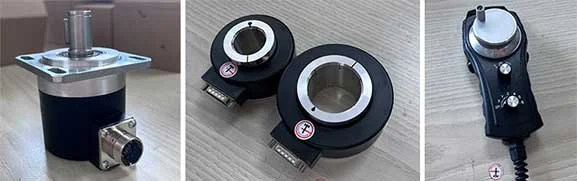
When selecting a motor encoder, consider the following factors:
Accuracy requirements: CNC spindles and servo systems require high-resolution encoders; general automation can use standard models.
Environmental conditions: For dusty, oily, or vibrating conditions, choose magnetic or capacitive types.
Mounting method: Select from solid shaft, hollow shaft, or integrated installation depending on motor design.
Signal interface: Confirm compatibility with your controller (TTL, HTL, RS422, SSI, CANopen, etc.).
Budget & maintenance: Incremental encoders are cost-effective; absolute encoders suit high-end, high-precision equipment.
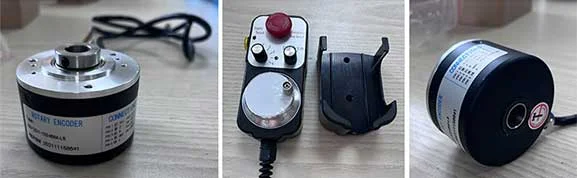
Motor encoders are vital components in modern industrial automation, providing accurate feedback and reliable control.
Whether for high-speed servo systems or multi-axis synchronized motion, the right encoder can significantly enhance machine performance, efficiency, and longevity.
Fagor Technology is dedicated to providing high-performance motor encoders, handwheel encoders, and CNC feedback systems with high accuracy, strong stability, and plug-and-play installation flexibility.Our encoders are widely used in CNC machines, industrial robots, and automated production lines.Contact Fagor Technology today to learn more about our encoder solutions — and power your automation systems with precision motion feedback.


 Tel: (86 510) 68088084
 Whatsapp: +86-15852791610
 Mailbox: info@wxfagor.com

