
 Email:
  Whatsapp:

Clear records
history record

PRODUCT
RELATED PRODUCT

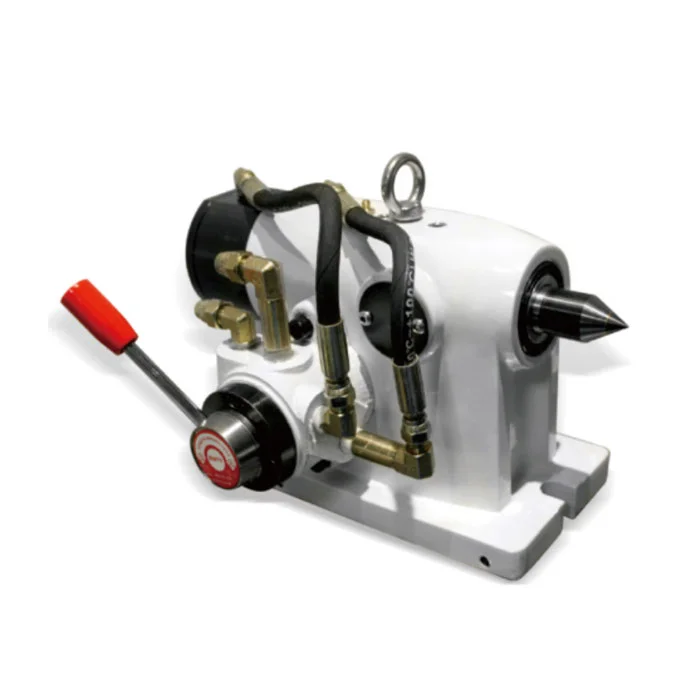
HYDRAULIC TAILSTOCK


Product Features
Hydraulic drive provides stable and constant clamping force, ensuring workpieces remain secure during machining.
Rigid structure with high-quality cast iron or alloy steel for excellent vibration resistance and durability.
Fully integrated with CNC systems for automatic extension, positioning, and clamping, improving machining efficiency.
Equipped with precision guideways and hydraulic cylinders for smooth movement and high repeat positioning accuracy.
Compatible with CNC lathes, machining centers, and rotary tables for various workpiece sizes.
Built-in hydraulic pressure monitoring and overload protection to prevent damage to workpieces or machines.
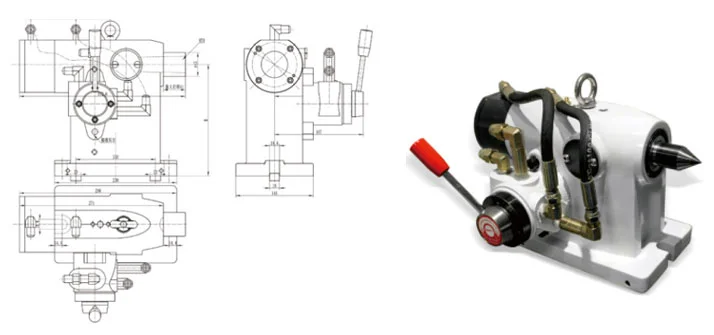
Product Dimensions
FAQ
Q1: What is a CNC hydraulic tailstock?
A1: A CNC hydraulic tailstock is a hydraulic-driven device designed to support long shaft workpieces during machining. It provides automatic extension and clamping, ensuring machining stability and accuracy.
Q2: When is a hydraulic tailstock necessary?
A2: A hydraulic tailstock is recommended when the length-to-diameter ratio (L/D) of a workpiece exceeds 3:1. It prevents deflection, vibration, and loss of accuracy during machining.
Q3: What are the differences between hydraulic, manual, and pneumatic tailstocks?
A3: Hydraulic tailstocks provide strong, adjustable, and stable clamping with higher automation. Manual tailstocks require operator skill and more setup time. Pneumatic tailstocks react faster but have weaker clamping force compared to hydraulic types.
Q4: How do I adjust hydraulic tailstock pressure to avoid taper or chatter issues?
A4: Set the pressure according to the workpiece material, diameter, and length. If you notice consistent taper, slightly increase the pressure. If the taper is inconsistent, the pressure may be too high and should be reduced.
Q5: What should I do if the workpiece vibrates or shows surface marks?
A5: Use M-codes (such as M21) or foot pedals to maintain constant pressure. Features like spindle speed variation (SSV) can also significantly reduce vibration.
Q6: How can I properly align a hydraulic tailstock?
A6: Clean the guideways, lightly clamp the tailstock, extend the quill, and use a dial indicator to check runout. Adjust with shims if the tailstock is too high, or grind the base if it is too low, until concentricity tolerance is within 0.02 mm.
Q7: How does a hydraulic tailstock improve stability when machining long shaft workpieces?
A7: By providing continuous axial support with constant pressure, it prevents workpiece sagging and vibration under cutting forces, ensuring better concentricity and surface finish.
Q8: What benefits does a hydraulic tailstock offer in heavy-duty machining?
A8: It delivers strong and stable support, resists high torque and heavy cutting loads, improves machining rigidity, and minimizes workpiece deformation compared to mechanical tailstocks.
Q9: Can a hydraulic tailstock be integrated with CNC systems or rotary tables for automation?
A9: Yes. Modern CNC systems allow hydraulic tailstocks to be controlled by M-codes or buttons, enabling automatic extension and clamping. They can also work with rotary tables for 4-axis or 5-axis machining, as well as automated production lines.

Contact Us
 Tel: (86 510) 68088084
 Whatsapp: +86-15852791610
 Mailbox: info@wxfagor.com

